
A Telescope Built for The Universe’s Shortest Stories
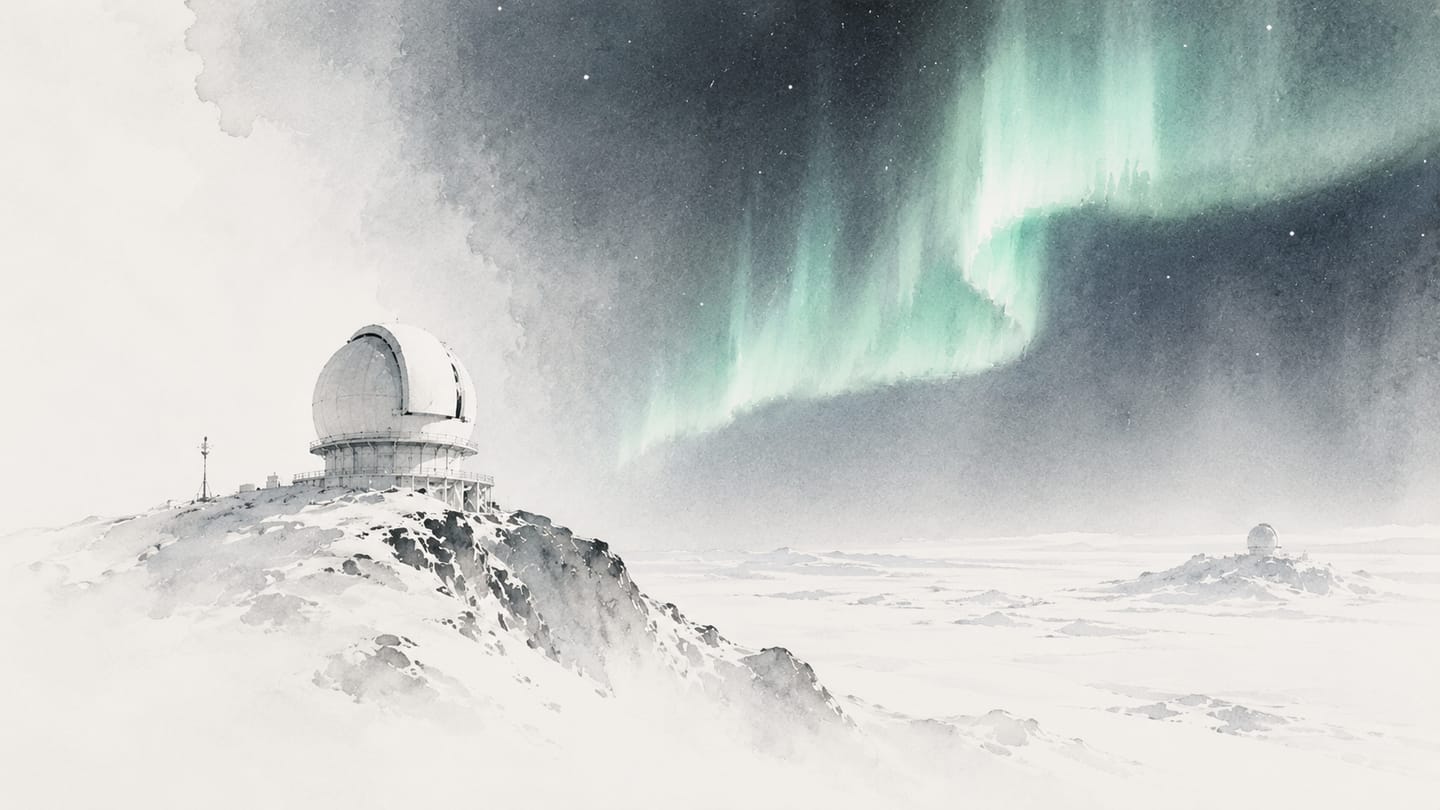
In Antarctica’s long winter night, the sky can stay dark not just for hours, but for months. That makes the continent one of the few places on Earth where an optical telescope can watch the same part of the sky again and again, without sunrise cutting the story in half. The Antarctic TianMu Staring Observation Project, or ATSOP, is a planned array of small telescopes designed to watch a large region around the South Celestial Pole with minute-scale sampling. The project’s prototype telescope, AT-Proto, has now operated at China’s Zhongshan Station for more than two years, testing whether this kind of polar sky watch can work in the cold, wind, low power, and limited network conditions of Antarctica.
May 12, 2026
Astronomy used to be mostly about mapping objects that appeared steady. Modern astronomy increasingly asks what changes, how fast, and why.
Some of the most interesting events in the sky unfold quickly. A star can flare. A compact binary can eclipse. A supernova shock can break out from a dying star. A gamma-ray burst afterglow can fade before a telescope on the other side of Earth gets darkness. The paper frames this as a gap in time-domain astronomy, the study of objects whose brightness changes with time. Existing large surveys are powerful, but many still revisit the same sky area on timescales of a day or longer, missing events that evolve within minutes to hours.
ATSOP aims to fill that gap from Antarctica. Its planned full system would use 30 small, wide-field telescopes to monitor about 1,200 square degrees around the South Celestial Pole. The goal is to observe objects brighter than magnitude 18 in 5-minute exposures, with simultaneous blue and red optical measurements during polar night. Magnitude is the astronomical brightness scale, where larger numbers mean fainter objects.
Why stare instead of scan?
Many sky surveys scan. They move from field to field, building coverage over time. ATSOP is built around a different idea: stare at one large sky region for a long time.
That choice matters because the earliest light from a transient can carry information that later observations cannot recover. A light curve, the record of brightness changing with time, can distinguish between physical models for explosions, flares, accretion events, and compact-object systems.
The target region is an annulus near the South Celestial Pole, from declination -75 degrees to -65 degrees. It covers 1,229 square degrees and includes part of the Galactic disk, higher Galactic-latitude regions, and the Large and Small Magellanic Clouds. This makes it useful for several kinds of science at once: variable stars in the Milky Way, extragalactic transients, and solar-system objects on high-inclination orbits.
The planned array would use two groups of telescopes, one observing in a blue band from 450 to 650 nanometers and the other in a red band from 650 to 850 nanometers. Measuring color at the same time as brightness helps astronomers classify stars and follow how explosions or afterglows cool and fade.
The prototype had to survive before it could discover
Before building a full Antarctic array, the team needed to answer a practical question: can a small optical telescope work reliably in Antarctica with little direct human help?
AT-Proto was designed around that constraint. It has a 180 millimeter aperture, a 9.5 by 9.5 degree field of view, a 220 millimeter focal length, and a 3k by 3k CCD detector. A charge-coupled device, or CCD, is a light-sensitive camera sensor used to turn incoming photons into an image.
The telescope sits inside a temperature-controlled dome. The dome contains the optics, camera, control electronics, and computers. Its window is made of fused silica and coated with indium tin oxide films that can be heated to prevent frost and condensation. The dome was first set to about 5 degrees Celsius and later adjusted to 8 degrees Celsius to improve protection against condensation.
This may sound like engineering detail, but it is central to the science. A telescope that cannot keep its electronics warm, its window clear, and its focus stable cannot produce reliable light curves.
Letting the sky drift across the detector
AT-Proto avoids one common source of trouble: moving tracking mechanisms.
Instead, it uses drift-scan CCD technology, also called time-delay integration. As Earth rotates, stars naturally drift across the detector. The camera shifts charge across the CCD at nearly the same rate, so light from a star keeps adding up while the image moves. In effect, the detector follows the sky electronically instead of forcing the telescope to follow it mechanically.
This reduces moving parts, power use, and failure points, which are all important in Antarctica. The paper argues that this makes drift-scan imaging well matched to remote, unattended polar observations.
There is a trade-off. At high declination, stars at different positions in a wide field do not drift at exactly the same rate. Long exposures can smear images, especially near the field edge. The team tested exposures of 10, 30, 60, and 110 seconds and found that 30 seconds gave the best balance between image quality, photometric precision, and avoiding saturation under bright sky conditions such as aurora or moonlight.
First light in the polar night
AT-Proto was shipped to Zhongshan Station on the icebreaker Xuelong on October 31, 2022. It achieved first light on February 19, 2023, meaning it recorded its first astronomical image at the Antarctic site. Trial observations began the next day.
The early results were practical and encouraging. The telescope did not require focus adjustment, and stellar images showed a full width at half maximum of about 2 pixels, matching laboratory tests. Full width at half maximum is a measure of image sharpness, giving the width of a star image at half its peak brightness.
During the 2023 observing season, AT-Proto collected 174,630 images, corresponding to 3.35 terabytes of data. In 2024, it continued fault-free operations and acquired about 150,000 images, or 2.8 terabytes, between May 31 and September 5.
The telescope also faced real Antarctic conditions. The paper reports operation at a minimum temperature of -37.3 degrees Celsius and maximum wind speeds of 38.6 meters per second, while maintaining usable image quality.
The numbers behind a reliable sky watch
The prototype’s performance tests show what the full project can build on.
For 30-second exposures on moonless nights, AT-Proto detected stars down to about 14.8 magnitude in the Gaia g band at signal-to-noise ratio 5. Signal-to-noise ratio measures how strongly a source stands out from noise. With 110-second exposures, the limit reached about 15.3 magnitude, but image trailing became worse. Stacking 10 frames can improve sensitivity by about 1.2 magnitudes, according to the paper.
The team also tracked image quality during different exposure times. For 10 and 30 seconds, star images peaked at about 1.4 and 1.6 pixels in width. At 60 seconds the peak was about 2 pixels. At 110 seconds, the maximum reached 6 pixels, showing strong degradation from trailing.
These tests set an observational strategy. The prototype is not simply proving that images can be taken in Antarctica. It is defining how the next telescopes should observe, how long each exposure should be, and how much image stacking may be needed.
Three kinds of fast-changing targets
The scientific program has three main targets.
The first is Galactic time-domain objects. These include variable stars, eclipsing binaries, flare stars, cataclysmic variables, and low-mass X-ray binaries. Many of these systems change on short timescales, and uninterrupted light curves can reveal eclipses, stellar pulsations, accretion changes, or magnetic flares.
The second is high-energy transient sources. These include optical counterparts of gravitational-wave events, supernovae, gamma-ray bursts, tidal disruption events, fast radio bursts, and other brief events. ATSOP would not replace deeper surveys, but it could catch early light that many surveys miss.
The third is high-inclination small bodies in the Solar System. Most known small bodies lie near the ecliptic plane, the plane of Earth’s orbit. Objects with high orbital inclination are less common in current samples. A polar staring survey can help search for and monitor such objects, including near-Earth objects, comets, Centaurs, trans-Neptunian objects, and possible interstellar small bodies.
Antarctica is useful, but not easy
The same environment that makes Antarctica attractive also makes it hard.
The paper lists five major engineering challenges: extreme low temperature, high wind, remote unattended operation, limited power, and limited network bandwidth. The prototype addresses these through a sealed heated dome, few moving parts, local image preprocessing, compressed data transfer, and remote control from Shanghai through satellite links.
Local preprocessing matters because raw images are large. The system can subtract background, extract sources, and transmit reduced information rather than sending every full raw frame in real time. That is important for rapid alerts, such as possible supernovae or gravitational-wave counterparts, when follow-up observations from other telescopes may be needed.
The paper also notes limits in the prototype. At Zhongshan Station, the telescope’s field of view was centered at declination -25 degrees, so a given target remained in the field for only about 40 minutes per day during polar night. The full ATSOP design aims at the South Celestial Pole region, where continuous staring will be more effective.
A small telescope as a pathfinder
AT-Proto is not the full survey. It is a pathfinder for the larger Antarctic TianMu array.
Its main result is not a single astronomical discovery, but a proof of operation: a drift-scan, wide-field, small-aperture telescope can run for years in Antarctica, collect large data sets, keep its internal environment stable, and produce images good enough for time-domain work. The paper reports no systemic failures during polar-night observations.
That matters because time-domain astronomy is often limited not only by telescope size, but by when and how often the sky can be watched. A small telescope in the right place, with the right observing strategy, can answer questions that a larger telescope may miss if it looks too late.
In the Antarctic winter, the sky gives astronomers something rare: time without daylight interruption. ATSOP is built to use that time, not by chasing the whole sky, but by watching one important region closely enough to catch the universe in the act of changing.
Antarctic TianMu Staring Observation Project I: Overview and Implementation of the Prototype Telescope Dan Zhou, Jing Zhong, Jianchun Shi, Zhenghong Tang, Shiyin Shen, Peng Jiang, Jie Zhu, Yong Yu, Lixin Zheng, Jianjun Cao, Guoping Chen, Xinyu Yao, Congcong Zhang, Lurun Shen, Hui Zhang, Xiang Pan, Chenwei Yang, Tuo Ji, Xian Shi, Hengxiao Guo, Zhen Yan, Donghai Zhao, Liang Chen, Jianeng Zhou, Minfeng Gu, Fuguo Xie, Wenbiao Han, Jinliang Hou, Bixuan Zhao, Wenwen Zuo, Chun Xu, Zhengyi Shao, Lei Hao, Jian Fu https://arxiv.org/abs/2512.24067v1