
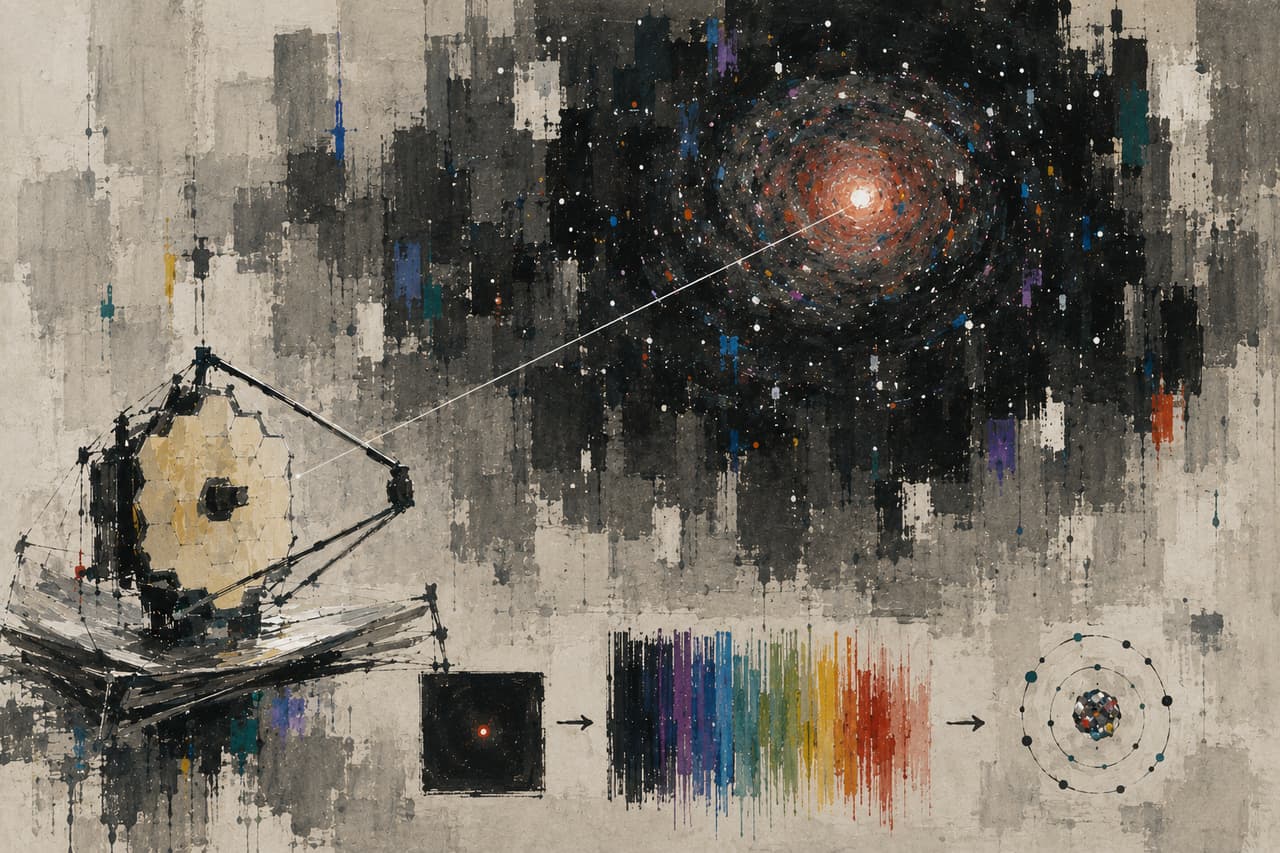
How Much Oxygen After the Big Bang? For the First Time, We Didn't Guess — We Measured
Astronomers have directly counted oxygen atoms in a galaxy 13.4 billion light-years away. The number is 4% of the Sun's. But the real story is how they got it.
May 12, 2026
The Faint Line Everyone Missed
In the summer of 2022, shortly after JWST's first images stunned the world, a small red dot caught astronomers' attention. It was too bright, too early — the universe was only 360 million years old, barely a toddler, and according to theory, there shouldn't have been a galaxy this massive yet.
They named it GHZ2, also known as GLASS-z12. Redshift 12.34.
Over the next two years, JWST kept pointing at that dot. NIRCam took pictures. NIRSpec split its light into a spectrum. Multiple teams published analyses. But one thing had never been done:
Count how much oxygen was actually in it.
Not estimated from a model. Not extrapolated from a calibration built for nearby galaxies. But measured directly — the way you'd use a thermometer to check water temperature before calculating something from first principles. That's the so-called "electron temperature method" — the Tₑ method — the gold standard for measuring chemical abundances in astrophysics for over thirty years.
Nobody had pulled it off at a redshift beyond 10. Because the key emission line — [OIII] 4364Å, called an "auroral line" — is agonizingly faint.
Now, Nielsen et al. have published the result in Astronomy & Astrophysics. They found it.
Every Galaxy Has a Barcode
Galaxies are more than collections of stars. The space between stars is filled with gas — mostly hydrogen and helium, plus a trace of heavier elements forged inside earlier generations of stars. (Astronomers, with their characteristic romance, call everything heavier than helium a "metal.")
When young, massive stars flood this gas with ultraviolet light, they strip electrons from atoms. As those atoms recapture electrons, they emit light at very specific wavelengths — emission lines. Each line corresponds to a particular element and ion. A galaxy's spectrum is, in effect, its barcode.
Most emission lines are bright and easy to spot. [OIII] 5007Å, for instance, is often the single strongest feature in a galaxy's spectrum.
But there's a special class: the auroral lines. These come from high-energy transitions within ions, and they only glow when the gas is hot enough to excite them. Their intensity depends directly on the gas temperature. And the gas temperature, in turn, depends on how many heavy elements are present — because those elements act as coolants, radiating heat away.
The logic is elegant: measure an auroral line → get the gas temperature → calculate the oxygen abundance from atomic physics. No calibration, no extrapolation, no model dependence. Just quantum mechanics, which works the same everywhere in the universe.
The catch: auroral lines are typically more than 100 times fainter than the bright lines. At redshift 12.34, cosmic expansion has stretched them from the ultraviolet into the infrared — right into JWST NIRSpec's sweet spot. Theoretically detectable. Practically? You need extraordinary signal-to-noise and a lot of exposure time.
Prying a Secret Out of the Noise
The Nielsen team pointed JWST's NIRSpec at GHZ2 in high-resolution mode and let it stare. NIRSpec doesn't take a single snapshot — it disperses the galaxy's light across a detector, spreading it by wavelength into a spectrum. Every emission line leaves a peak.
The bright lines had already been seen by earlier teams: CIV, HeII, [OIII] 5007Å, [OII] 3727Å. Well catalogued.
What Nielsen's team was hunting was a nearly invisible bump buried in noise: [OIII] 4364Å. They analyzed the spectrum point by point around the expected wavelength, verifying the statistical significance of the signal. And they didn't stop there — they also detected the [OIII] 1666Å auroral line, even fainter, in the far ultraviolet. Two auroral lines, independent of each other, both present.
That was the confirmation. They had a direct temperature measurement.
The electron temperature came in around 20,000–25,000 K. Plug that into the equations —
Oxygen abundance: 12+log(O/H) = 6.98 ± 0.13.
In human terms: this galaxy contains about 4% of the Sun's oxygen.
Not Just the Oxygen — the Surprise Was the Calm
The 4%-solar number itself isn't shocking. At 360 million years after the Big Bang, only a few of the first generation of stars had lived and died. The heavy elements they manufactured hadn't yet accumulated much. Theory predicted roughly this level.
The real surprise was something else: the ionization parameter.
The ionization parameter, log(U), describes how many high-energy photons are available to ionize the surrounding gas. Higher values mean a more intense radiation field, a more "extreme" environment.
The Nielsen team's result: log(U) = −2.86 ± 0.16.
That is low. Not "extreme." Not "unprecedented." It's comparable to ordinary star-forming galaxies in the local universe today.
This stands in striking contrast to many earlier JWST studies, which had painted a picture of z > 10 galaxies as extreme ionization environments — dense, furious, unlike anything nearby. Some groups had reported high ionization parameters for GHZ2 itself, using strong-line diagnostics.
A direct Tₑ measurement tells a quieter story. At least for this galaxy, the gas is not being blasted by some exotic radiation field. It's relatively calm.
Why This Changes the Measuring Stick
For thirty years, the Tₑ method has been the standard for nearby galaxies. But at z > 10, every previous oxygen abundance — for GHZ2 and every other high-redshift galaxy — had relied on "strong-line methods": take a few of the brightest emission lines, plug them into empirical calibrations built from local galaxies, and get an estimate.
It's like estimating distance by saying "well, a train ticket from Beijing to Shanghai costs about 500 yuan, and it's roughly 0.5 yuan per kilometer." The formula might work for routes you've calibrated — but does it hold on a different continent, in a different century?
The Tₑ method is different. It's a ruler — because atomic physics doesn't change with redshift. Ionization cross-sections, recombination coefficients, transition probabilities — these are constants of nature, the same in GHZ2 as they are in a lab on Earth.
Nielsen's direct measurement lines up with some strong-line calibrations — and disagrees significantly with others. That mismatch is itself a finding: at least some of the widely-used indirect methods need recalibration in the high-redshift regime.
This Is One Galaxy, Not a Census
Let's not overstate it. GHZ2 is a single data point.
It's also an outlier in brightness — one of the most luminous galaxies known at z > 10. Whether its properties represent "typical" galaxies of this era, we simply don't know.
Auroral line detection demands exceptionally high signal-to-noise. Most z > 10 galaxies are too faint for JWST to tease out this line, even with longer exposures. Expanding from one galaxy to a statistical sample will require ambitious observing programs and many more hours of telescope time — and JWST time is one of the scarcest resources in modern astronomy.
Still, the first data point is always the hardest. GHZ2 proves it's possible.
The Light Is Still Traveling
The [OIII] 4364Å auroral line from GHZ2 left the galaxy as ultraviolet light, was stretched to the infrared by 13.4 billion years of cosmic expansion, and finally landed on JWST's detector — a few dozen photons carrying the temperature of gas in a galaxy that existed when the universe was 2% of its current age.
During those 13.4 billion years, the universe cooled from a plasma fireball, assembled the first stars and galaxies, and built up the chemical complexity that eventually produced the Sun, the Earth, and every oxygen atom in every breath you take.
GHZ2's 4% solar oxygen is the first page of that story. For the first time, we've actually read the number on it.
JWST NIRSpec Spectroscopy of the Remarkable Bright Galaxy GHZ2/GLASS-z12 at Redshift 12.34 Marco Castellano, Lorenzo Napolitano, Adriano Fontana, Guido Roberts-Borsani, Tommaso Treu, Eros Vanzella, Jorge A. Zavala, Pablo Arrabal Haro, Antonello Calabrò, Mario Llerena https://iopscience.iop.org/article/10.3847/1538-4357/ad5f88