Organizing Committee
B. Bertotti; I. Ciufolini; G. Coyne; T. Damour; M. Dobrowolny; J. Ehlers; C.W.F. Everitt; L.Z. Fang; R.W. Hellings; R. Jantzen; S. Leschiutta; Y. Ne'eman; K. Nordtvedt; U. Ponzi; R. Ruffini
William Fairbank Meetings
The first William Fairbank Meeting gathered experimentalists and theorists in Rome to discuss precision tests of gravitation, space experiments, cryogenics, clocks, and gravitational radiation.
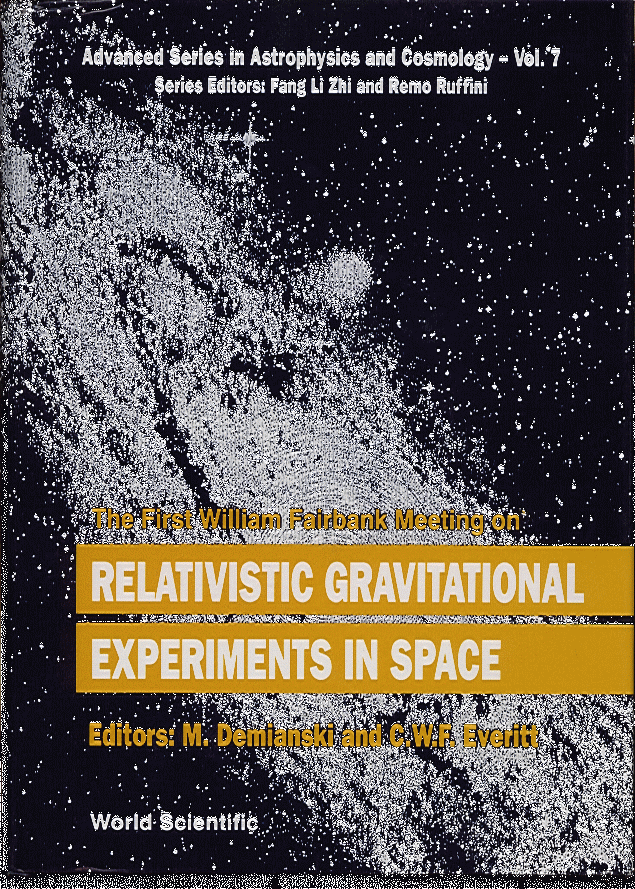
The First William Fairbank Meeting on Relativistic Gravitational Experiments in Space was held at the University of Rome "La Sapienza" under the auspices of ICRA. The meeting honored William M. Fairbank, whose work connected low-temperature experimental physics, precision measurement, and ambitious tests of gravitation.
Almost 80 physicists and engineers joined the program from relativistic gravitation, space research, SQUID technology, large-scale cryogenics, clock technology, laser and radar science, and related fields. The organizers described the meeting as an effort to keep alive the open technical exchange and scientific imagination associated with Fairbank.
The program connected foundational tests, space missions, frame dragging, gravitational radiation, and spacecraft technology. It included discussions of STEP, Gravity Probe A and B, equivalence principle tests, cryogenic gravitational wave detectors, LAGEOS, and advanced space instrumentation.
The topics below summarize the scientific scope preserved in the historical meeting materials.
Tests of underlying principles in gravitational physics and their theoretical rationale
Frameworks for testing gravitational theories, present status of theory testing, and future prospects
Rotational effects in general relativity, frame dragging, and the geodetic effect
Experiments and theory of gravitational radiation
Advanced technologies: clocks, drag-free systems, and cryogenics in space
Classical gravity
Spacecraft design, program management, and use of the Columbus space station
The names listed here follow the migrated legacy archive for this meeting.
B. Bertotti; I. Ciufolini; G. Coyne; T. Damour; M. Dobrowolny; J. Ehlers; C.W.F. Everitt; L.Z. Fang; R.W. Hellings; R. Jantzen; S. Leschiutta; Y. Ne'eman; K. Nordtvedt; U. Ponzi; R. Ruffini
M. Demianski; C.W.F. Everitt; Fang Li Zhi; Remo Ruffini