
Awards
TEST Award
Traction of Events in Space-Time
TEST:
Traction of Events in Space-Time
Anna Imponente
National Gallery of Modern Art, Rome
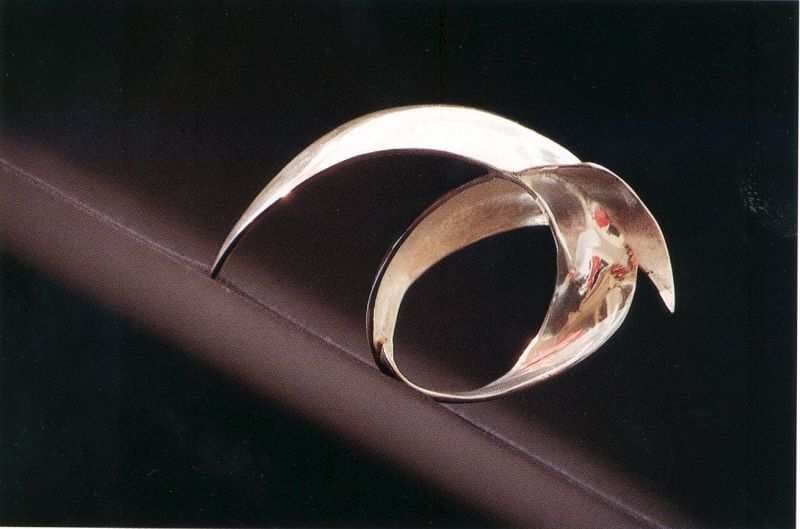
The TEST sculpture provides an innovative example of interaction between science and art, not as the abstract result of a later critical reading, but as the outcome of an active and creative collaboration between an astrophysicist and a sculptor.
To understand the meaning of collaboration between scientists and artists, and to trace its historical roots, we have to go back to the Renaissance. There we find the idea of a Weltanschauung and of unitary art as a continuous and inseparable process of recognizing the structure of reality. This spirit underlies Leonardo da Vinci's talent, expressed in his drawings, where scientific inquiry and artistic research are never separated.
In the seventeenth century, that link was loosened by the 'climb to the stars' of stage machinery in Baroque scenography, nourished by imagination. On the one hand stood experimental Galilean science, pursuing exact research toward a rational understanding of the universe; on the other, the flourishing of subjectivity, taste, feeling, the beaux arts, and the specialization of painting into separate genres.
In the nineteenth century, however, the trend began to reverse. The scientific achievements of H. L. Helmholtz in optics and E. Chevreul in chemistry helped pointillist painters think in terms of the separation of color. At the beginning of the twentieth century, the Cubist revolution of 1907 transformed the concepts of space and time toward a simultaneity of vision, in step with Einstein's theory of special relativity of 1905.
The relationship between Remo Ruffini and Attilio Pierelli was not that of a director and an implementer, nor can it be described exactly as a two-handed performance. It was instead a line of work suggested to the artist by a graphic design already tested scientifically and computerized by M. Johnston and Ruffini at Princeton University in 1974. That investigation concerned the geometric motion of five particles in space-time according to a solution of Einstein's equations, and the visible replica of a phenomenon in our own galaxy: the black hole, a stellar mass drawn into itself by gravitational collapse under its own self-gravity.
The encounter between Ruffini and Pierelli was not accidental. Ruffini, in investigating astrophysical laws, has always combined exact results with an awareness of the natural elegance of formulas, approaching the detailed calculations through an aesthetic lens. Pierelli, in turn, satisfies his appetite for geometry through reflective symmetries and perspective-driven visions based on proportion, seeking to show the poetry of pure science before it becomes a technological adventure. In developing his work on space, he also surveyed the history of mathematical thought and non-Euclidean geometry, drawing hyperspatial forms from the investigations of Gerolamo Saccheri, a seventeenth-century Jesuit philosopher and mathematician.
Ruffini compares the intuition behind this new form, derived from the integration of Einstein's equations and the trajectories of bodies around a black hole, to the Greeks' discovery of pi and the circle, which led to Hellenic architecture and the column. In 1981, the architectural novelty of the form was already recognized by Maurizio Sacripanti, who saw it as a space one can enter with one's own body and perceive directly with the senses.
The beginning of the project has the flavor of a challenge the sculptor sets for himself: to represent trajectories in plastic form through their spatial coordinates, height, width, and length, and to reinterpret them as an aesthetic object, using his own judgment to verify its artistic coherence.
The realization of the project is conceptually complex and revolutionary. It is meant to describe a motion, but not a terrestrial one, and not the motion of a body released in the Earth's gravitational field. Rather, it resembles a Möbius strip without being so simple, because it is differentially dragged by the rotational field of the black hole in the geometry of space-time. The acronym TEST stands for Traction of Events in Space-Time. The sculpture therefore has no privileged interpretive direction and no pedestal that would anchor it to a central perspective: no top or bottom, no right side or left side. Any orientation yields a complete and faithful realization.
One should imagine it in rotation, with its surface independent of any relation to the source of natural light. In sculpture, ambiance is fundamental. The metal light alone outlines and designs the vision of the rotating black hole. The transformation of this sequence of events into a solid form is achieved by abstracting their properties and reducing everything to a direct perception of their essence, a Wesenschau. This representation does not lend itself to psychological or science-fiction interpretation. Rather, the collective imagination can perceive an emotional projection and exemplification of the universe, because the form is prehensile and seems to absorb matter. The title TEST also accidentally includes the monogram ET, which recalls the mythical encounter with the extraterrestrial in Steven Spielberg's film, itself borrowing the famous finger contact from Michelangelo's Creation of Man in the Sistine Chapel.
From a scientific point of view, the clear and lucid form of the sculpture may recall the application of mathematical logic to ideographic instantaneity carried out by Giuseppe Peano at the end of the nineteenth century. From an artistic perspective, it can be related to Russian Constructivism around 1920 and to Naum Gabo's early perception of the unity of visible forms and the existence of aesthetic forms only in accordance with physical and mathematical laws.
In the later context of the late 1970s, marked by strong neo-expressionist and subjectivist movements, or by a neo-mannerist reassessment of the art of the past, interaction with science often meant the adoption of advanced technologies, the so-called computer art. Yet the use of media different from the traditional ones changes only the visual perception of the image and produces technical updating without necessarily yielding a new artistic message. A conceptually new image can also be expressed through traditional and time-tested techniques. Its novelty may appear in modules of different sizes and compositions: as a 20-centimeter silver object in 1985, as a 50-centimeter bronze version, or as steel tubes in the 340 x 470 x 260 centimeter structure shown at the Venice Biennale in 1986.
In the silence of his studio, the artist finds his craft in making the molds to be forged into metal and in his attempts to achieve the right shape of the torsions that express the intuition of artistic value, with the light and opacity of the metal. He tries not to betray the accuracy promised by the measurements of the curvatures and seeks to make them coincide with his own geometric dream. The discovery of a form that is not an invention, but the simple beauty and perfection of an archetype existing in nature, allows one to re-experience aesthetically the same emotion felt by whoever first discovered it.
English translation by Susanna Hirsch.